Heritage Tourism
Penatuhkah Comanche Trail Partnership
Historical Landmarks
Introduction to Comanche Smoke Signaling
By Linda Pelon
The topic of Smoke Signaling is fascinating! The sophistication of landscape navigation and the communications systems of these Texas Comanches was admired by both the Texas Rangers and the United States Army. It was so effective that Texans and US Army officers attending the Butler-LewisTreaty Talks in Waco during the US/Mexican War (1846=48) complained that Comanches had updates on the battles in South Texas in this war before the army.
Landscape Navigation The Penatuhkah Comanche band controlled most of Texas at the peak of the horse culture and they traveled widely in Texas. They communicated over long distances using smoke signals. And they used rock art maps as reminders of how to get to places and travel within them. These skills were taught in the warrior training camps. They also used Comanche Marker Trees as landscape navigations aids (see section on Marker Trees in our previous section on Ecotourism. These trees may point toward a spring or other resource, identify campsites, low water crossing and much more.
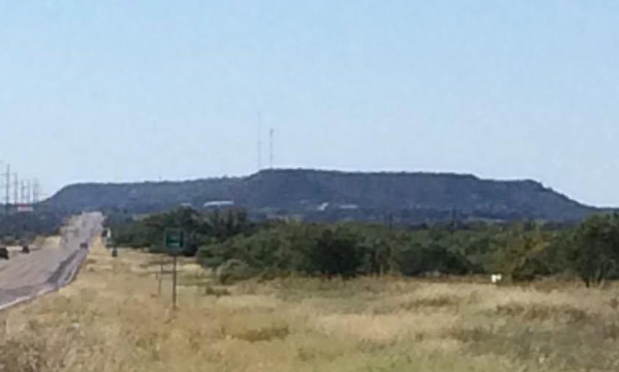
Santa Anna Peaks in Coleman County Texas. It is obvious from the antennas on these peaks that they are still used for signaling.
The warrior training camp at Santa Anna’s Peaks taught not only the skills of war but also the communication and navigating skills that gave them great advantages. It was a surprise when research indicated Comanche “Adivas” (woman chiefs) ran these training camps. Harston’s book Comanche Land reported oral historical information about these warrior training camps collected from Texas chiefs still living during the reservation period. This information focuses on Conas (the Comanche name for the twin mesas now called Santa Anna Peaks and named for the last principal chief of the Texas horse culture Santanna/Santa Anna)). Conas was the military center for the Penatuhkah Band. Santa Anna’s mother was once the “Adiva” of this training camp that educated warriors [I suspect that including a woman’s perspective on fighting from horseback would have been an advantage to Comanche warriors since women think differently from men]. It was also the training center for smoke signaling. These 300 feet tall mesas are on a lift that is almost 2,000 feet above sea level with commanding views of the region. Smoke signaling relay stations are visible in all directions from these twin peaks. Harston’s oral histories claim that Comanches could get a signal for the Chisos Mountains to Black Mesa (in what is now Oklahoma) in one day. That is fascinating! And I have invested many years trying to reconstruct it….maybe you can help! Please send me the names of the highpoints you can identify from the mesas near you and send us that information. Or contact us if you would like to train to become a scout for the Penatuhkah Comanche Trails.
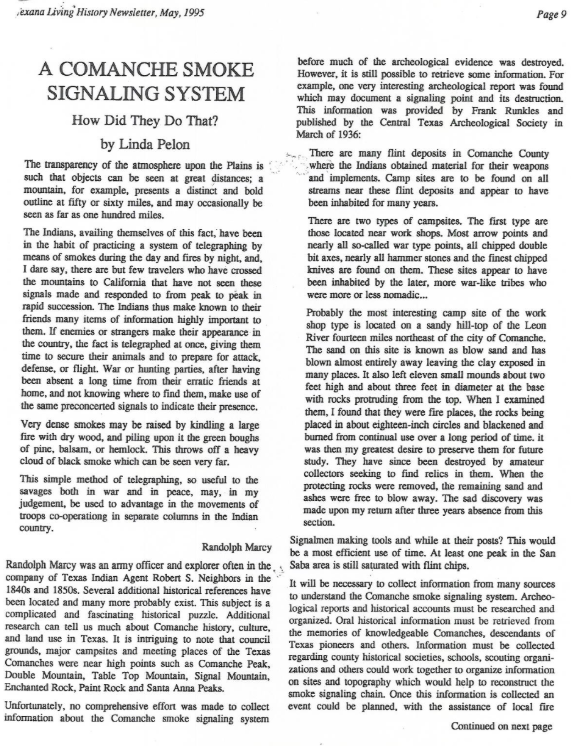
(page 2 was omitted because it contained no additional significant information)
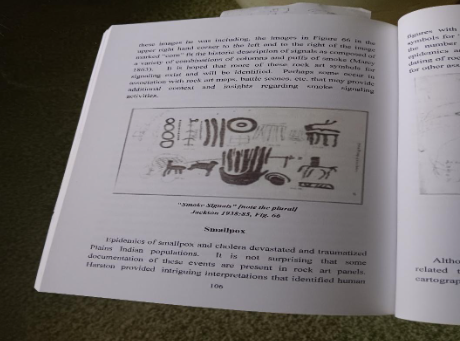
Rock Art Images/Pictographs of Comanche Smoke Signaling
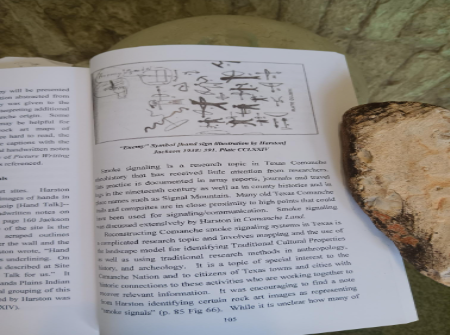
Information about Smoke Signaling images is from the rock art chapter of Comanche Land Revisited and informed by oral histories from Comanche “Picture Chief” Deer Head during the Comanche Reservation Period and collected by Harston. More of this information is in his book Comanche Land and more is archived at the University of Texas at Austin. Much more was recently discovered when Harston’s grandson donated his personal papers to the Comanche Nation. There is an unpublished rock art manuscript and much more. I am currently in possession of these papers and am reading them and arranging them to be archived.